
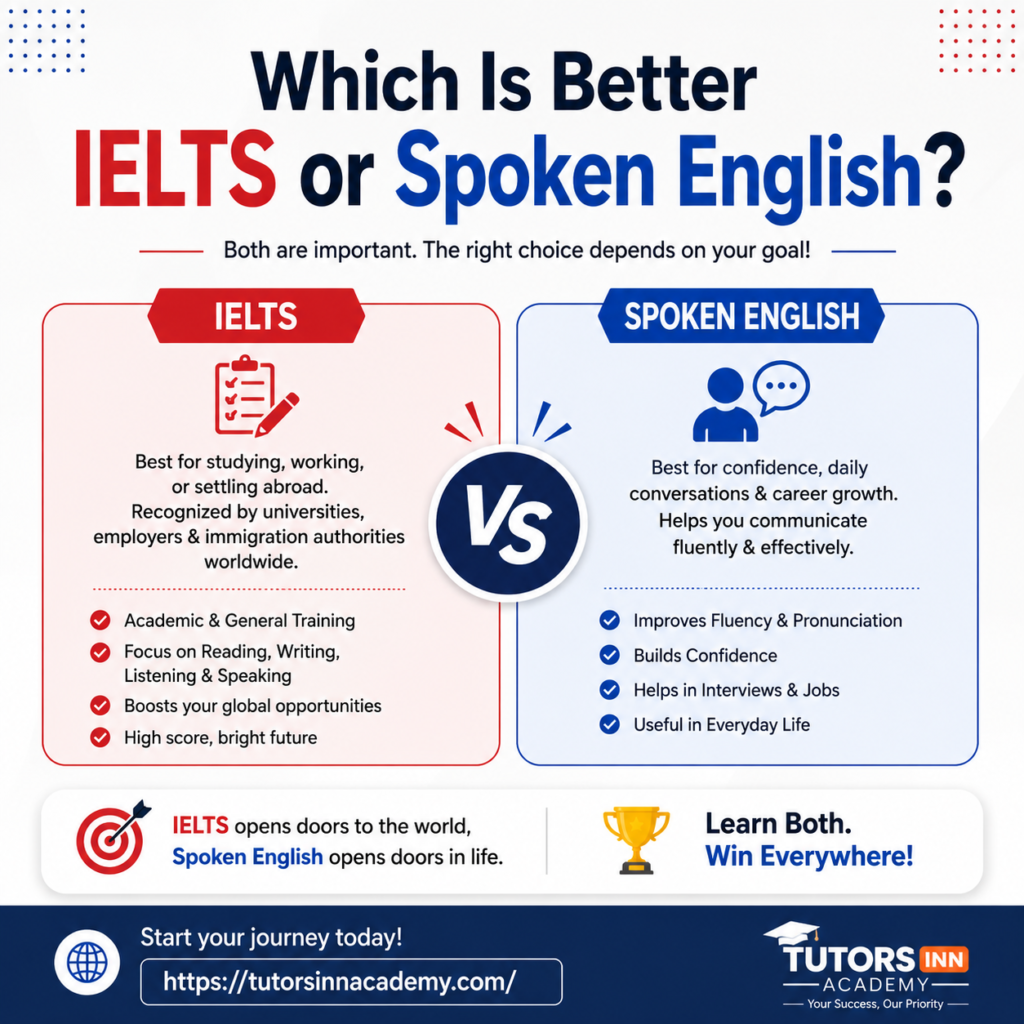
Many students and professionals often ask, “Which is better, IELTS or Spoken English?” The answer depends on your goals. While both focus on improving English language skills, they serve different purposes. IELTS is an internationally recognized English proficiency test, whereas spoken English courses focus on improving everyday communication and fluency.
If you are confused about whether to choose IELTS preparation or spoken English training, this guide will help you understand the differences and decide which option is best for your needs.
What Is IELTS?
IELTS (International English Language Testing System) is one of the world’s most recognized English language exams. It is designed to assess a person’s ability to use English in academic, professional, and immigration settings.
The IELTS test evaluates four language skills:
- Listening
- Reading
- Writing
- Speaking
Universities, employers, and immigration authorities in countries such as the UK, Canada, Australia, New Zealand, and the UAE often require IELTS scores as proof of English proficiency.
Who Should Choose IELTS?
IELTS is ideal for:
- Students planning to study abroad
- Professionals seeking international job opportunities
- Individuals applying for immigration visas
- People who need an official English language certification
What Is Spoken English?
Spoken English focuses on developing practical communication skills used in daily life, workplaces, meetings, interviews, and social interactions.
A spoken English course typically includes:
- Vocabulary building
- Pronunciation improvement
- Conversation practice
- Grammar correction
- Public speaking confidence
- Communication skills
Unlike IELTS, spoken English training does not usually involve formal examinations or internationally recognized certifications.
Who Should Choose Spoken English?
Spoken English is suitable for:
- Beginners learning English communication
- Students wanting to improve fluency
- Job seekers preparing for interviews
- Professionals aiming to communicate confidently at work
- Individuals who feel nervous while speaking English
Which Is Better for Students?
If your goal is to study in another country, IELTS is usually the better option. Most universities require IELTS scores during admission.
However, many students struggle with speaking confidence even after preparing for IELTS. In such cases, combining spoken English practice with IELTS preparation can deliver better results.
Which Is Better for Jobs?
The answer depends on where you want to work.
For International Jobs
IELTS may be required by employers in some countries. A strong IELTS score demonstrates your English proficiency and can strengthen your job application.
For Local and Corporate Jobs
Spoken English skills are often more valuable in day-to-day workplace communication. Employers appreciate candidates who can communicate clearly in meetings, presentations, and customer interactions.
Which Is Better for Beginners?
For beginners, spoken English is often the best starting point.
Learning conversational English helps build:
- Confidence
- Vocabulary
- Pronunciation
- Basic grammar skills
Once you become comfortable communicating in English, preparing for IELTS becomes much easier.
Can You Learn Spoken English Through IELTS?
Yes, but only to a certain extent.
The IELTS speaking section improves communication skills, but the primary objective is achieving a target band score rather than developing natural conversation abilities.
Someone with a high IELTS score may still struggle in casual conversations if they have not practiced spoken English regularly.
Can You Do Both Together?
Absolutely.
Many English language experts recommend combining IELTS preparation with spoken English training.
Benefits include:
- Better speaking confidence
- Improved pronunciation
- Enhanced vocabulary
- Higher IELTS speaking scores
- Stronger communication skills for work and study
A balanced approach helps learners succeed both in exams and real-life communication situations.
When Should You Choose IELTS?
Choose IELTS if you:
- Need admission to a foreign university
- Are applying for immigration
- Need an official English proficiency certificate
- Want to meet visa requirements
- Plan to work abroad
When Should You Choose Spoken English?
Choose spoken English if you:
- Want to speak English fluently
- Need better communication skills
- Are preparing for job interviews
- Want to improve workplace communication
- Feel nervous speaking English
Final Verdict: Which Is Better IELTS or Spoken English?
Neither IELTS nor spoken English is universally better—they serve different purposes.
If your goal is studying abroad, immigration, or obtaining an internationally recognized certification, IELTS is the right choice.
If your goal is improving communication, fluency, confidence, and daily conversation skills, spoken English training is the better option.
For the best results, many learners benefit from combining both. Spoken English builds confidence and communication skills, while IELTS provides a recognized qualification that can open doors to education, employment, and immigration opportunities worldwide.
FAQs
Is IELTS harder than spoken English?
IELTS is generally more challenging because it tests listening, reading, writing, and speaking under exam conditions.
Can I get a job with spoken English only?
Yes, many local and corporate jobs value strong communication skills. However, some international opportunities may require IELTS scores.
Does IELTS improve speaking skills?
Yes, IELTS preparation can improve speaking skills, but it mainly focuses on exam performance rather than everyday conversation.
Which is best for beginners: IELTS or spoken English?
Spoken English is usually better for beginners because it builds confidence and communication skills before moving on to IELTS preparation.
Can I prepare for IELTS without spoken English classes?
Yes, but spoken English practice can significantly improve your IELTS speaking performance and overall confidence.