
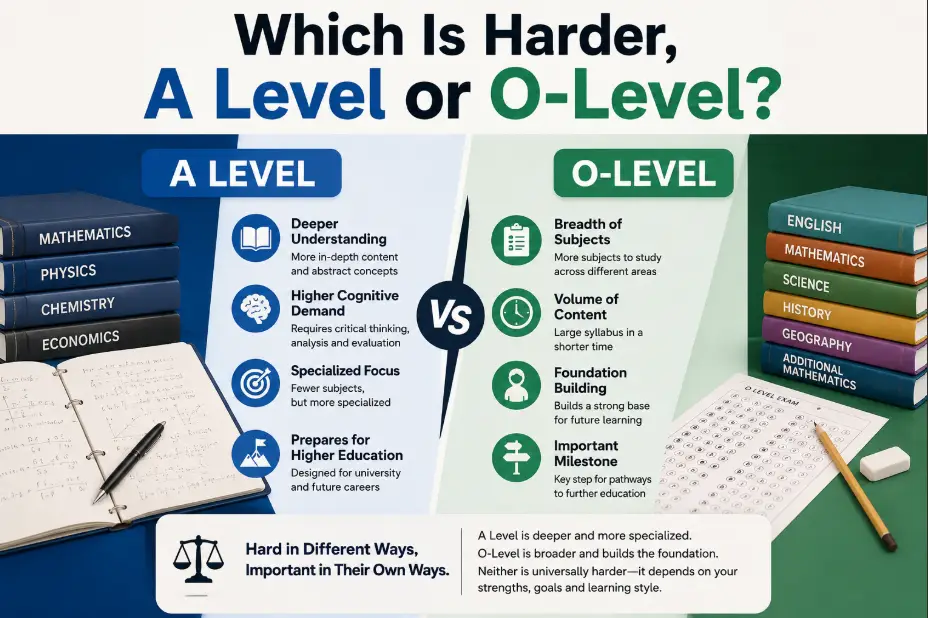
Students planning their academic journey often ask an important question: Which is harder, A Level or O-Level? Understanding the difference between these two qualifications can help students prepare better for future studies and career goals.
Both O-Level and A Level are internationally recognized qualifications offered under the British education system. However, they differ significantly in terms of difficulty, subject depth, study methods, and academic expectations.
In this article, we will compare O-Level and A Level in detail to help students understand which one is more challenging and why.
What Is O-Level?
O-Level, short for Ordinary Level, is usually completed by students between the ages of 14 and 16. It serves as a foundation for higher education and prepares students for advanced studies.
Students typically study a wide range of subjects, including:
- Mathematics
- English Language
- Physics
- Chemistry
- Biology
- Computer Science
- Business Studies
- Economics
The primary goal of O-Level is to provide students with broad knowledge across different academic areas.
What Is A Level?
A Level, or Advanced Level, is the next stage after completing O-Level. Students generally study A Levels between the ages of 16 and 18.
Unlike O-Level, A Level requires students to specialize in a smaller number of subjects. For example, a student interested in engineering may choose:
- Mathematics
- Physics
- Further Mathematics
Similarly, a student pursuing medicine may select:
- Biology
- Chemistry
- Mathematics
A Level focuses on in-depth learning and advanced concepts that prepare students for university education.
Is A Level Harder Than O-Level?
In most cases, A Level is considered significantly harder than O-Level.
While O-Level introduces fundamental concepts, A Level requires students to:
- Analyze complex information
- Apply theoretical knowledge
- Solve advanced problems
- Conduct independent research
- Develop critical thinking skills
The jump from O-Level to A Level can be challenging because students move from basic understanding to deeper academic analysis.
Comparison Between O-Level and A Level
1. Subject Complexity
One of the biggest differences is the complexity of subjects.
In O-Level, students learn introductory concepts. For example, mathematics focuses on algebra, geometry, and basic statistics.
In A Level Mathematics, students encounter:
- Advanced calculus
- Trigonometric identities
- Differential equations
- Probability distributions
- Mechanics
The same pattern applies to sciences and other subjects.
2. Depth of Knowledge
O-Level provides broad coverage of topics.
A Level goes much deeper into each subject. Students are expected to understand not only what happens but also why it happens.
For example:
- O-Level Biology explains how cells function.
- A Level Biology explores cellular processes, genetics, molecular biology, and biochemical pathways in greater detail.
This deeper understanding makes A Level more demanding.
3. Study Hours Required
O-Level students can often succeed with regular classroom learning and moderate revision.
A Level students usually need:
- Extensive self-study
- Detailed note-taking
- Practice papers
- Research-based learning
Many students spend significantly more hours studying for A Levels compared to O-Levels.
4. Examination Style
O-Level exams primarily test knowledge and understanding.
A Level exams focus more on:
- Analysis
- Evaluation
- Application of concepts
- Problem-solving
Students must demonstrate a higher level of intellectual ability rather than simply memorizing information.
5. Independent Learning
A major challenge of A Level is independent learning.
Teachers guide students, but much of the responsibility falls on the student. Success often depends on:
- Time management
- Self-discipline
- Consistent revision
Students who rely solely on classroom teaching may struggle at A Level.
Why Do Students Find A Levels Difficult?
Several factors contribute to the increased difficulty of A Levels.
Increased Academic Pressure
A Level grades play a major role in university admissions. Many top universities require excellent A Level results.
This creates pressure to perform well academically.
Advanced Concepts
Subjects become much more specialized and detailed.
For example:
- Chemistry includes organic mechanisms and advanced physical chemistry.
- Physics introduces advanced mechanics and complex calculations.
- Economics involves detailed market analysis and economic theories.
Limited Subject Choices
Since students usually take only three or four subjects, each subject carries greater importance. Poor performance in one subject can significantly affect university applications.
Are O-Levels Easy?
Although O-Level is easier compared to A Level, it should not be considered easy.
Students still need to:
- Understand key concepts
- Complete coursework
- Practice exam techniques
- Manage multiple subjects
Strong O-Level performance creates a solid foundation for success at A Level.
Which Subjects Become Much Harder at A Level?
Some subjects experience a particularly large increase in difficulty.
Mathematics
Many students find A Level Mathematics substantially harder due to calculus, statistics, and advanced problem-solving.
Physics
A Level Physics requires strong mathematical skills and a deeper understanding of scientific principles.
Chemistry
Chemistry becomes more analytical, with complex reactions and calculations.
Biology
Students must memorize and understand extensive scientific details while applying knowledge in unfamiliar situations.
Economics
The subject moves from basic concepts to detailed economic theories and analytical essays.
How Can Students Succeed in A Levels?
Although A Levels are challenging, students can perform well with the right approach.
Create a Study Schedule
A structured study plan helps manage workload and reduce stress.
Practice Past Papers
Past papers improve exam technique and familiarity with question patterns.
Focus on Understanding
Avoid rote memorization. Understanding concepts deeply leads to better results.
Seek Additional Support
Many students benefit from:
- Online tuition
- Subject tutors
- Study groups
- Academic mentoring
Revise Consistently
Regular revision prevents last-minute pressure and improves long-term retention.
Which Qualification Is More Important?
Both qualifications are important, but they serve different purposes.
O-Level
- Builds academic foundations
- Develops core skills
- Prepares students for advanced studies
A Level
- Determines university eligibility
- Demonstrates subject expertise
- Prepares students for higher education
Universities generally place greater emphasis on A Level results because they reflect a student’s readiness for degree-level study.
Final Verdict
When comparing the two qualifications, A Level is undoubtedly harder than O-Level. The curriculum is more advanced, the subjects are studied in greater depth, and students are expected to think critically and independently.
However, O-Level should not be underestimated. It provides the essential knowledge and skills needed for success in A Level studies.
Students who build strong foundations during O-Level, develop effective study habits, and stay consistent with their preparation are more likely to excel in A Levels and achieve their academic goals.
Ultimately, the transition from O-Level to A Level is challenging but manageable with dedication, proper guidance, and a commitment to continuous learning.